
If a 143 just popped up on your phone, relax. Nobody sent you a math problem or a secret bank code. It is one of the oldest and cutest number codes in texting, and it carries a very warm message. In this guide, you will learn exactly what 143 means, where people use it, how to reply, whether it can ever feel awkward, and where it came from. You will also see real chat examples so you can spot the right tone every time.
What Does 143 Mean in Text?
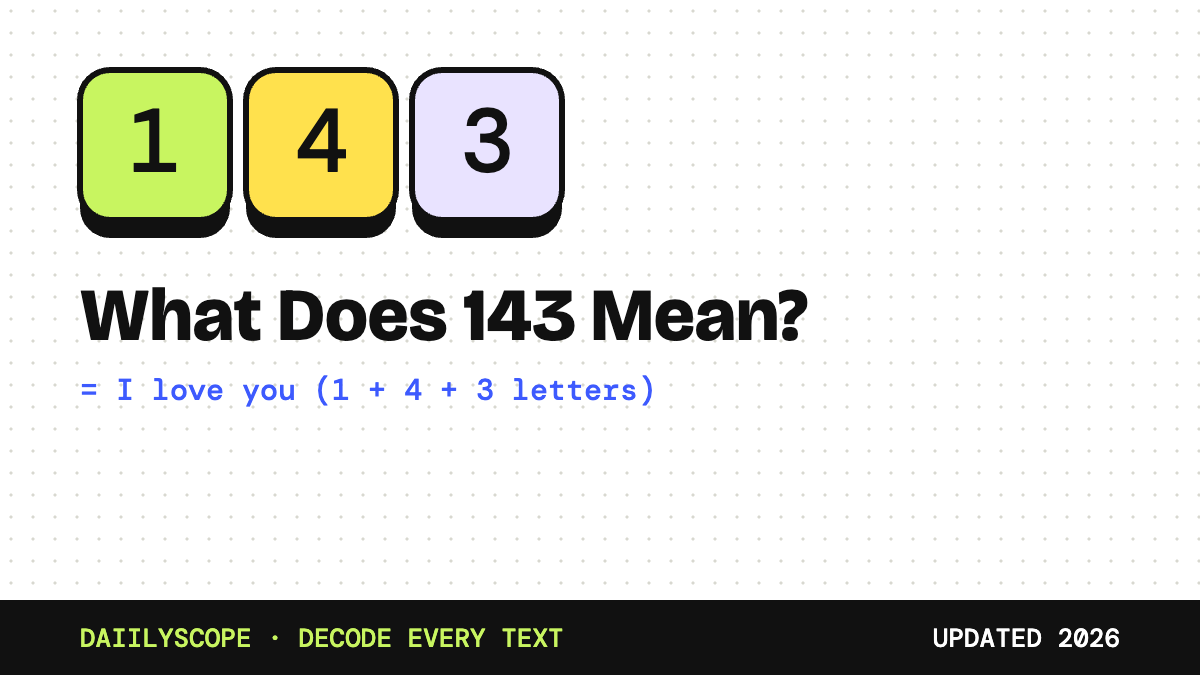
In plain English, 143 = I love you. The trick is simple. Count the letters in each word of the phrase. “I” has one letter, “love” has four letters, and “you” has three letters. Put those numbers side by side and you get 143.
That is why 143 feels a little like a secret handshake. Someone who knows the code reads it instantly. Someone who doesn’t might just see a random number. That small mystery is part of the charm. It lets people say something big in a quiet, playful way.
Most of the time, 143 is romantic. Partners, crushes and people in long-distance relationships use it a lot. But it is not only for couples. Family members, best friends and even parents texting their kids use 143 to say “I love you” without making it a big moment.
There are a few close cousins of 143 you may also see. 1432 means “I love you too,” because the 2 sounds like “too.” 143637 stretches it to “I love you always and forever,” and 831 means “I love you” too, but with a different trick: 8 letters, 3 words, 1 meaning. We cover those codes in our number codes section.
Where People Use 143
You can find 143 on almost every app where people chat. The meaning stays the same, but the mood changes a little depending on the platform.
- TikTok: People drop 143 in comments under cute couple videos, pet clips or wholesome family moments. It is a fast way to show love for the creator or the people in the video.
- Snapchat: Couples and close friends send 143 as a caption on a quick snap, often with a heart or a sleepy selfie at night.
- Instagram: You may see 143 in bios, in captions for anniversary posts, or in DMs between partners. A bio like “143 forever” usually points to a relationship.
- WhatsApp: Families use 143 in group chats, especially parents and grandparents who learned it years ago. It also shows up in sweet good-night messages.
- SMS: Plain text messages are where 143 started. Older phones had tiny keypads, so short codes like this saved time and effort.
The common thread is closeness. People rarely send 143 to someone they just met. It shows up between people who already share some warmth, which is why getting one usually feels nice.
10 Real Chat Examples of 143
Seeing 143 inside a real conversation makes the meaning click. Here are ten short chats that show the different ways people use it.
1. A sweet good-night text
ALong day. Going to sleep now 😴
BSleep well. 143
A1432 💛
2. A long-distance couple
ALanded safe ✈️
BFinally!! Missed you so much
A143, see you in two weeks
3. A mom texting her teen
AGood luck on your test today!
BThanks mom, I’m nervous
AYou studied hard. 143 ❤️
4. Best friends after a hard week
AThanks for listening to me cry for an hour lol
BThat’s what I’m here for
A143 bestie
5. A shy crush
ACan I tell you something?
BOf course
A143… okay bye 🙈
6. A playful couple
AYou ate the last cookie didn’t you
BMaybe. 143 though?
ANice try. Still 143 🙄
7. Grandparents in a family chat
AHappy birthday sweetheart! 143 from Grandma and Grandpa 🎂
BThank you!! 143 to you both
ACall us later 😊
8. Someone who doesn’t know the code
A143
B143 what? Like 143 dollars?
AIt means I love you, silly 😂
9. Making up after a fight
ASorry I snapped earlier
BIt’s okay, I was tired too
A143. Pizza tonight?
10. Signing off a long call
AOkay I really have to go now
BMe too. Talk tomorrow?
AYes. 143, bye!
How to Reply to 143
Replying to 143 depends on who sent it and how you feel. The good news is that there is no wrong way to be kind. Here are reply ideas for every mood.
1432 💛
The classic reply. It means “I love you too” and shows you know the code.Wow, 143? I was expecting at least 1,000
A playful tease that keeps things light while still showing you are happy.Aw, 143 back!
Easy and warm. Good for friends and family.That’s sweet, thank you 😊
Kind and honest if you are not ready to say it back.If someone sends 143 and you don’t feel the same way, you don’t have to fake it. A gentle “That’s really sweet of you” is fine. If it is a friend, they may simply mean friendly love. If it is a crush, a kind, honest reply is better than silence.
If you want to match their energy, add an emoji. A heart, a hug emoji or a sparkle makes the reply feel warmer without needing extra words. You can check what each emoji usually means in our emoji meanings guides.
Is 143 Rude?
No, 143 is not rude. It is one of the sweetest number codes you can receive. It carries love, care and a little bit of playfulness.
That said, context still matters. Sending 143 to a coworker you barely know, or to someone who has made it clear they want space, can feel awkward or too personal. The code itself is kind, but love messages should match the relationship. It is also worth knowing that some people, especially younger texters, may not know what 143 means. If they reply with confusion, just explain it with a smile.
Some people also worry that 143 feels lazy compared to typing “I love you.” For most people, it doesn’t. The code has a cute, nostalgic feel, and many couples use it on purpose as a private little habit. If you want to say it for the very first time, though, typing the full words or saying it out loud may feel more meaningful.
Who Uses 143?
143 crosses generations, which is unusual for texting slang. Here is who uses it most often:
- Couples of all ages, especially long-distance partners who text a lot.
- Parents and grandparents, who often learned the code in the pager or flip-phone days.
- Teens and young adults, who use it as a cute, slightly secret way to say “love you” to friends or crushes.
- Filipino texters, where 143 is famous and used widely in daily life.
- Fans online, who sometimes comment 143 to show love to a favorite creator or celebrity.
Because so many groups use it, 143 rarely feels outdated. It is more like a classic than a trend.
Origin of 143
The code goes back to the pager era of the 1980s and 1990s. Pagers could only show numbers, so people invented number codes to send short messages. 143 was perfect: three digits, easy to remember and full of meaning.
Many people also link 143 to an old lighthouse story. The lighthouse on Minot’s Ledge, off the coast of Massachusetts, began flashing a 1-4-3 light pattern in 1894. Locals came to call it the “I love you” light, and the nickname still sticks today. Whether you believe the story or not, it adds a lovely image to a simple number. You can read more about the lighthouse on Wikipedia.
When cell phones and SMS arrived, the code moved from pagers to texts. It later spread across social media. Today you still see it everywhere, from TikTok comments to WhatsApp family chats. For a broader look at how texting shortcuts grow and change, the Wikipedia page on SMS language is a good read.
143 vs Other Common Texting Terms
Here is how 143 compares with a few other popular abbreviations you will see in chats.
| Term | Meaning | Type | Usage | Popularity |
|---|---|---|---|---|
| 143 | I love you | Number code | Partners, family, close friends | High |
| IDK | I don’t know | Abbreviation | Any casual chat | Very high |
| IDC | I don’t care | Abbreviation | Casual, can sound blunt | High |
| IMO | In my opinion | Abbreviation | Debates, reviews, comments | High |
| BRB | Be right back | Abbreviation | Chats, gaming, calls | Very high |
The big difference is the feeling. IDK, IDC, IMO and BRB are about information. 143 is about emotion. That is why it sits in a special group with codes like 1432 and 831, which you can explore in our texting abbreviations guides.
Real-World Usage Example
Picture this. Maya and Sam have been dating for a year, but Sam just moved to another city for work. Their schedules are packed, and some days they only have time for a few texts.
Every night before bed, Maya sends a single message: “143.” Sam replies “1432.” It takes two seconds, but it says everything. On busy days, those three numbers are the most important part of their chat. One night Sam is too tired to type more, so he simply sends a photo of the moon with the caption “143.” Maya saves it.
That is the real power of 143. It turns a busy, tired moment into a small promise. It does not need a long paragraph. It just needs three numbers and two people who know what they mean.
FAQs About 143
What does 143 mean in text?
143 means “I love you.” Each number matches the number of letters in each word: I (1), love (4), you (3). People use it as a short, sweet and slightly secret way to share love.
What does 1432 mean?
1432 means “I love you too.” It is the classic reply to 143. The 2 is a sound-alike for “too,” a common texting trick. Some people write 1433 instead, counting the three letters of “too.”
Is 143 romantic or friendly?
It can be both. Between partners and crushes it is romantic. Between family members and best friends it is friendly, caring love. The relationship tells you which one it is.
How should I reply to 143?
If you feel the same, reply 1432 or “143 back.” If you are not sure, a kind “That’s sweet, thank you” works. You never have to say it back if you don’t mean it.
Where did 143 come from?
143 started as a pager code in the 1980s and 1990s, when people could only send numbers. Many also link it to a Massachusetts lighthouse whose 1-4-3 flashes are nicknamed the “I love you” light.
Conclusion
143 is a tiny code with a big heart. It means “I love you,” and people use it with partners, family and close friends on every app, from TikTok to WhatsApp. It is never rude, it has a sweet history, and replying is easy. Just send 1432 if you feel the same, or a kind thank-you if you don’t.
Next time three little numbers show up on your screen, you will know exactly what they mean. And if any other code or abbreviation confuses you, paste it into our Text Decoder or browse more number codes to stay fluent in text.

Jake explains what emojis and number codes really mean in a message, from 143 to the crying-laughing face.